
Could Passenger Trains Return to Detroit’s Michigan Central Station?
Plan Calls for New Intermodal Facility Next to Recently Restored Building

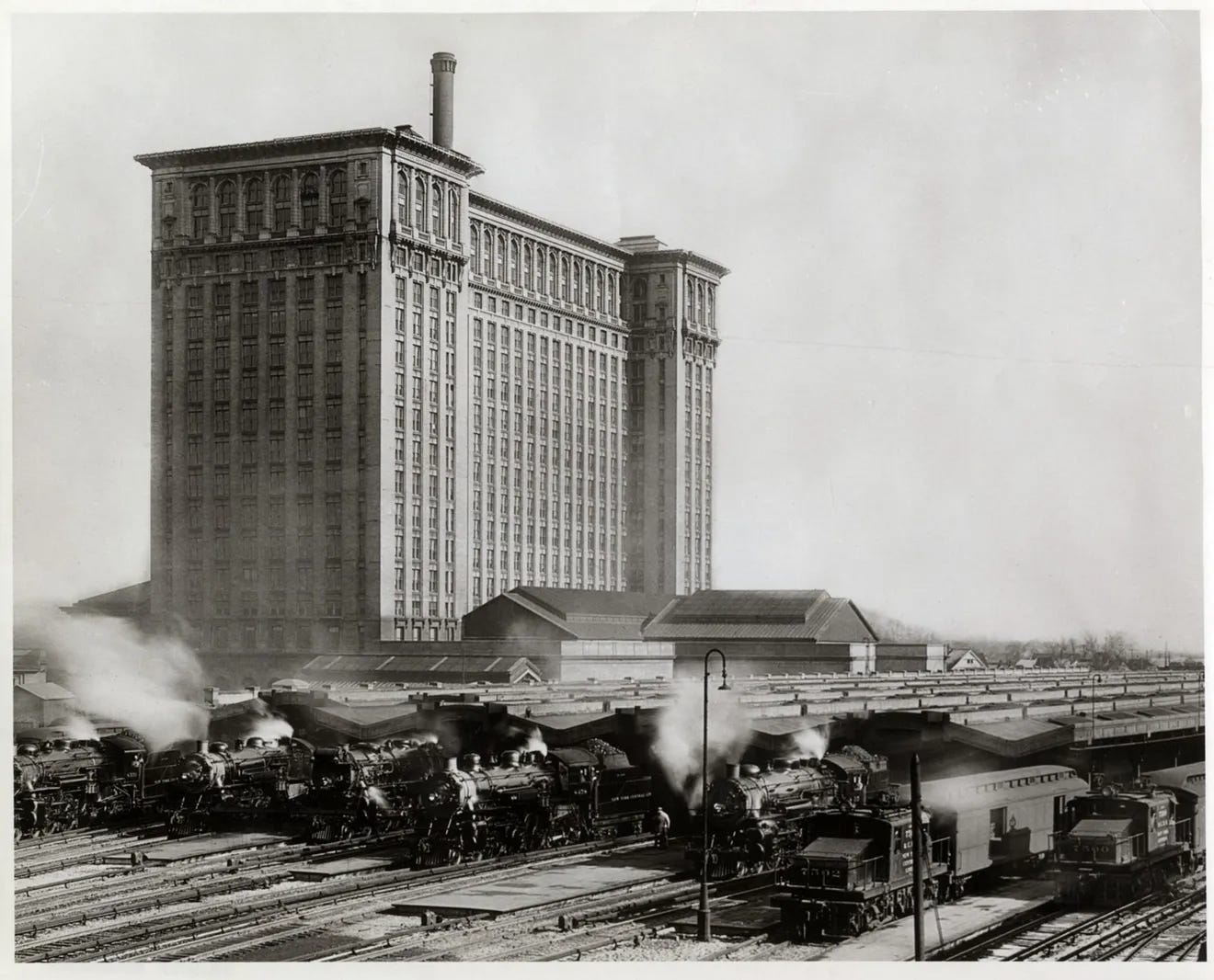
Detroit, Michigan, is home to one of the grandest railroad stations in the United States, Michigan Central. It was built by the Michigan Central Railroad, a subsidiary of the New York Central System, and opened in 1913.
In 1960 I had the privilege of traveling through Michigan Central when my family rode the New York Central’s Wolverine on the way to my cousin’s bar mitzvah in Flint. The station looked like a slightly smaller version of New York’s Grand Central Terminal where we boarded the train the night before. Disclosure: They used the same architects.
The station remained in use until 1988, when Amtrak moved to a smaller facility on Detroit’s north side. Then it sat vacant for 30 years while vandals had their way with it and became a symbol of Rust Belt urban decay.
Eventually, the station found a white knight from a most unlikely source, Ford Motor Co., one of America’s Big Three auto manufacturers; i.e., the folks who put the railroads out of the passenger business. Ford purchased Michigan Central from its then-owner, the Moroun family, in 2018 with plans to restore it for use as a hub for its autonomous vehicle development program.
Six years later the station was opened to the public after Ford spent upwards of $1 billion on its restoration and building out the adjacent Corktown campus. Now there is talk of bringing trains back to Michigan Central…well sorta.
Last month the Michigan Central Corp., the campus developer, Michigan Department of Transportation (MDOT), and the city of Detroit signed a memorandum of understanding to develop an intermodal facility just west of the station. If the project stays on schedule it could open by the end of 2028.
Because its underground passageways and platforms were destroyed after it closed there is no access from the restored station building to the railroad tracks. Consequently, a separate structure needs to be built to serve Amtrak and the intercity bus lines.
MDOT wants the new station to facilitate passenger service between Chicago, Detroit, and Toronto. The current Detroit station on West Baltimore Avenue is too far from the rail tunnel between Detroit and Windsor, ON. The tracks on the American side that lead to the tunnel are directly behind Michigan Central. The Windsor extension is expected to generate 66,000 rail trips.
The operating plan for the new service calls for one of the Wolverine Service trains that now serve Pontiac to be rerouted to Windsor. There detraining passengers would go through Canadian customs and transfer to a waiting VIA Rail train to London and Toronto.
In the 1950s the Canadian Pacific Railway had a similar arrangement. A one-car train would run from Michigan Central to the CPR station in Windsor. The lone coach would be attached to a Toronto- bound train while American passengers cleared customs.
The existing Amtrak station in Detroit would remain in use for trains to and from Pontiac. It is not clear whether those trains would also stop at the new station.
Michigan has committed $40 million to the project for early design and engineering, $10 million of which comes from a federal grant. The Canadian share is $36 million but a funding source have yet to be identified. Without support from Canada, the service would terminate in Detroit.
Other new rail lines could utilize the new intermodal facility. The Ohio Rail Development Commission is producing a service development plan for a new rail line that would serve Cleveland, Toledo, and Detroit. ORDC is participating in the Federal Railroad Administration’s Corridor Identification and Development Program, which is creating a pipeline of rail projects ready for implementation.
The Cleveland – Toledo – Detroit route could attract commuters who live in Toledo and work in Detroit and vice versa, says John Easterly, executive director of the rail advocacy group All Aboard Ohio. “If the service is time appropriately and priced appropriately, I could see people really using this as an option to get to and from work,” he told WTVG.
The High-Speed Rail Alliance in a blog post urged transportation planners and government leaders to look beyond a single train to Windsor. “We believe there should be a dozen round trips – otherwise a market won’t develop, and the hundreds of millions invested to get the service running won’t be amortized.”
NYC TRANSIT
14 Customer Service Centers to Help Riders Adapt to Major Changes
With two subway lines swapping routes in December, a transition to a new payment technology, and a fare hike coming in January, New York City subway riders are bound to have questions. New York City Transit, the agency that runs the subways, is rolling out 14 new customer service centers around the system to help them get answers.
The service centers are successors to the token booths that are being phased out, Two have already opened at the Coney Island – Stillwell Avenue and Grand Central – 42nd Street stations and a dozen more are to be placed in service by year’s end.
With the exception of St. George on the Staten Island Railway, the centers will be staffed 24/7. Agents will answer travelers’ questions, assist with the new tap-and-go OMNY technology, help people sign up for programs such as Fair Fares, and provide service information.
“We’re making it even easier for customers to get assistance by meeting them where they are with new customer service centers coming to locations throughout the transit system,” NYC Transit President Demetrius Crichlow said. “As we continue to transition to tap-and-ride, customers can easily transfer funds from MetroCards to OMNY at their nearest customer service center where knowledgeable station agents are there to help.”
One of the first tests for the centers will be route changes for the F and M trains effective December 8. Between 6:30 am and 9 pm weekdays F trains will run between Queens and Manhattan via the 53rd Street Line and Queens Plaza before turning south to run beneath Sixth Avenue. The M train will run via 63rd Street and Roosevelt Island. Evening, late night, and weekend routes will remain the same for both lines.
MTA officials say the change eliminates a merge at Queens Plaza that causes delays for Queens Boulevard Line riders.
Holiday Hiatus
Taking next week off to enjoy the holiday with my family. Happy Thanksgiving to you and yours.
- Ellis
As for the Michigan Central Station part of your post, what a really uplifting story! Hope springs eternal.
I was also pleasantly surprised to find in the photo, the two trains piloted by electric locomotives. Quite a juxtaposition.