
Amtrak Expects to Set New Record for Thanksgiving Travel
Reports Double-Digit Growth in Early Bookings

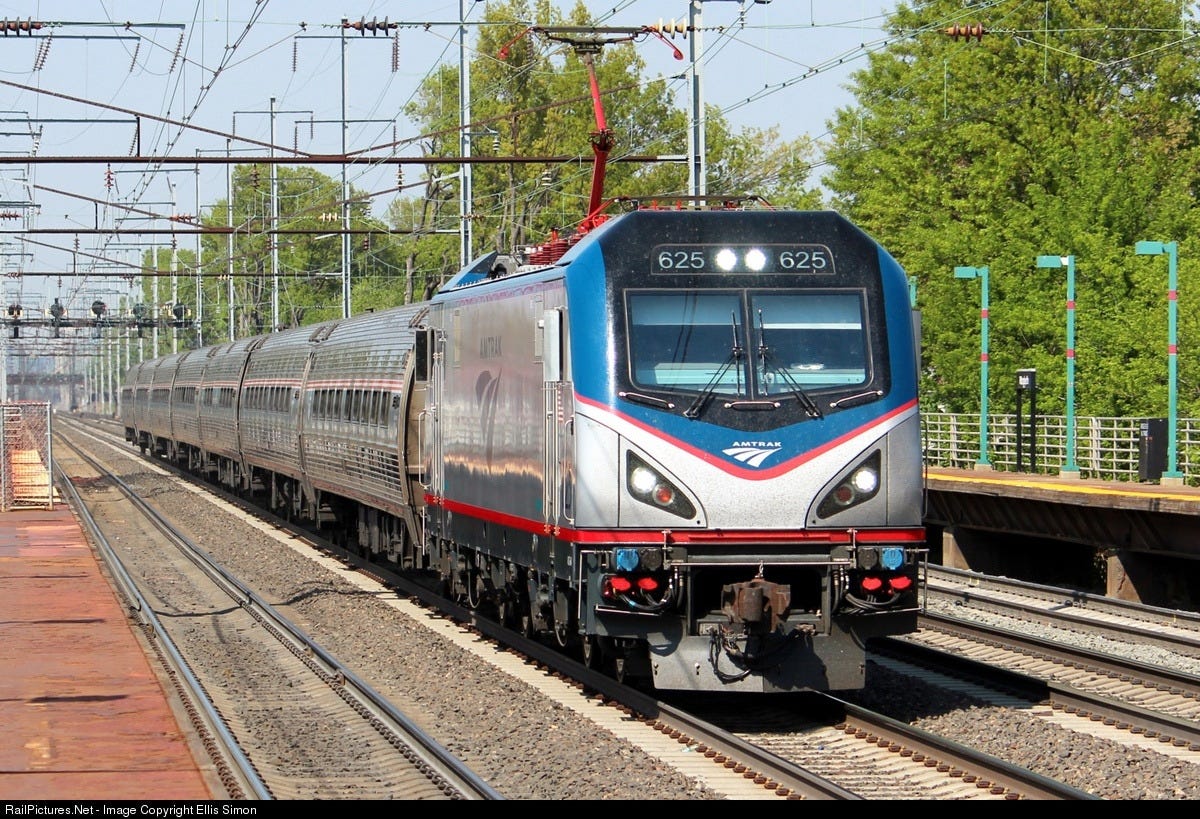
Amtrak is predicting record-breaking ridership for the 2025 Thanksgiving travel period, which runs from November 25 through December 1. Last year the railroad carried 1.2 million passengers during its busiest week, and it reports double-digit growth in early bookings for this year’s holiday.
Between November 25 and 30 trains in the Northeast Corridor will run with extra cars, and service to New York, Philadelphia, Washington, and Boston will be expanded. Amtrak urges passengers to purchase tickets as soon as possible to avoid higher fares for last-minute bookings.
While Amtrak’s numbers are impressive, they represent a small fraction of the 81.8 million people expected to travel at least 50 miles for turkey and all the trimmings, according to the American Automobile Association. This is a two percent increase over the 2024 or 1.6 million additional travelers.
The overwhelming majority – 73 million people – will drive, putting an additional 1.3 million cars on the road and adding to traffic congestion. Another six million will fly. The remaining 2.5 million will go by train, bus, or ship. This “other” category, i.e. neither auto or air, is seeing the fastest growth, with an 8.5 percent year over year increase and a 29.3 percent gain since 2019.
Most of Amtrak’s holiday travel will be in the Northeast Corridor. A large share of these riders will be college students on break heading home to spend Thanksgiving with family and friends.
Regional railroads are also preparing for holiday travel. The Long Island Railroad will offer expanded service and adjusted schedules for Thanksgiving Day travel on its Babylon and Ronkonkoma lines. Trains will be added on the Hempstead Line, and Port Jefferson Line schedules will be adjusted, as well. In addition, the LIRR will run extra trains between Jamaica and Penn Station for travel to the Macy’s Thanksgiving Parade.
In Connecticut, CTRail will provide additional service on the Hartford Line with four extra round trips on Tuesday, November 25, and Wednesday, November 26, and three added round trips on Sunday, November 30. It will follow a Saturday schedule on Thanksgiving Day, November 25. The Hartford Line runs between New Haven and Springfield, MA.
Shore Line East, which operates between New Haven and New London, will follow a weekend schedule on Thanksgiving Day and a regular weekday schedule the next day. Metro North will operate on a special schedule for Thanksgiving Day and follow a Saturday schedule on Friday, November 28.
SEPTA
Bus, Trolley, and Subway Workers Authorize Union Chief to Call a Strike
As if it doesn’t already have enough trouble between fiscal woes and train cancellations, last Sunday the union representing SEPTA bus, trolley, and subway operators voted to authorize a strike if a new contract agreement cannot be reached. A strike would force hundreds of thousands of Philadelphians to find another way to get to work and school.
While the vote gives Will Vera, president of Transit Workers Union Local 234, the power to lead workers off the job at any time, he currently is not considering a work stoppage. “I am not talking a strike. If SEPTA starts to bargain fairly, we will make progress,” he said.
However, TWU international president John Samuelson was more militant. “If SEPTA doesn’t put more money on the table we’re going to shut Philly down,” he said.
The biggest obstacle to an agreement is sick policy. The union also wants a two-year contract to succeed the recently ended one-year agreement.
“It’s really hard for my members to collect sick pay and there are too many penalties on my members if we don’t hand in our paperwork as soon as possible,” Vera said.
The 5,000 SEPTA employees represented by Local 234 have been working without a contract since November 7. The last time the union went out on strike was in 2016.
In a statement SEPTA called the strike authorization vote a normal part of the process. The statement said contract talks have been productive and the agency looks forward to continuing to negotiate in good faith.
ILLINOIS DOT
Funding Package Assembled to Build Chicago – Quad Cities Passenger Line
Legislation passed late last month that bails out Chicago-area transit agencies also includes a provision to start passenger service between Chicago and the Quad Cities. The route was discontinued in 1978 by the bankrupt Rock Island Railroad. It would enable people to make same-day round trips between Chicago and Moline, IL, and help promote tourism in the Quad Cities.
The law includes a one-time $300 million appropriation for “intercity passenger rail capital startup,” most of which would go toward establishing the new service. The remainder would be used to study and plan a Chicago – Peoria route.
When added to $475 million previously secured, the appropriation gives the project enough funds to cover its $750 million estimated cost. The money will pay to upgrade 56 miles of the Iowa Interstate mainline, including new signals, sidings, and positive train control, and to build a connection in Wyanet from BNSF. Top speed would be 79 mph. Iowa Interstate runs from Chicago to Council Bluffs, IA, over the former Rock Island mainline.
Trains would travel over BNSF from Chicago to Wyanet, which is just west of Princeton, IL, and Iowa Interstate from there to Moline. A new station will be built at Geneseo. In Moline trains would stop at the Quad Cities Multi-Modal station, a facility opened in 2018 to serve buses and the new rail line.
At first, the route would have two daily round trips. State Sen. Mike Halpin, who helped secure the funding, told the High-Speed Rail Alliance the goal is to have trains cover the route in 2 ½ hours, which was the Rock Island’s best time in the post-World War II era. However, Amtrak trains are carded at 1:46 to run from Chicago to Princeton, which would leave just 44 minutes to run the remaining 60 miles to Moline.